PHYSICS
Physics is the natural science that
studies matter,[a] its fundamental constituents, its motion and
behavior through space and time, and the related entities of energy and force. Physics is one
of the most fundamental scientific disciplines, and its main goal is to
understand how the universe behaves.
Physics is one of the oldest academic disciplines and, through its
inclusion of astronomy, perhaps the oldest.
Over much of the past two millennia, physics, chemistry, biology,
and certain branches of mathematics were a part of natural philosophy, but during the Scientific Revolution in the 17th century
these natural sciences emerged as unique research endeavors in their own right. Physics
intersects with many interdisciplinary areas of research, such
as biophysics and quantum
chemistry, and the boundaries of physics are not rigidly defined. New ideas in physics often
explain the fundamental mechanisms studied by other sciences and
suggest new avenues of research in academic disciplines such as mathematics
and philosophy.
Advances in physics often enable advances in new technologies.
For example, advances in the understanding of electromagnetism, solid-state physics, and nuclear physics led
directly to the development of new products that have dramatically transformed
modern-day society, such as television, computers, domestic appliances, and nuclear weapons advances
in thermodynamics led to the development
of industrialization; and advances in mechanics inspired
the development of calculus.
Ancient astronomy
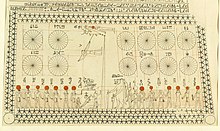
Ancient Egyptian astronomy is
evident in monuments like the ceiling of
Senemut's tomb from the Eighteenth Dynasty of
Egypt.
Astronomy is one of
the oldest natural sciences. Early
civilizations dating back before 3000 BCE, such as the Sumerians, ancient Egyptians, and the Indus Valley
Civilisation, had a predictive knowledge and a basic awareness of
the motions of the Sun, Moon, and stars. The stars and planets, believed to
represent gods, were often worshipped. While the explanations for the observed
positions of the stars were often unscientific and lacking in evidence, these
early observations laid the foundation for later astronomy, as the stars were
found to traverse great circles across
the sky, which however did not explain the positions of the planets.
According to Asger Aaboe, the origins of Western astronomy can be found in Mesopotamia, and all Western efforts in the exact sciences are descended from late Babylonian astronomy. Egyptian astronomers left
monuments showing knowledge of the constellations and the motions of the
celestial bodies, while Greek poet Homer wrote
of various celestial objects in his Iliad and Odyssey; later Greek astronomers provided names, which are still used
today, for most constellations visible from the Northern Hemisphere.
Natural philosophy
Natural philosophy has
its origins in Greece during the Archaic period (650 BCE – 480 BCE), when pre-Socratic philosophers like Thales rejected non-naturalistic explanations
for natural phenomena and proclaimed that every event had a natural cause. They proposed ideas verified by reason and observation,
and many of their hypotheses proved successful in experiment; for example, atomism was found to be correct approximately 2000 years
after it was proposed by Leucippus and his
pupil Democritus.
Medieval European and Islamic
The Western Roman Empire fell
in the fifth century, and this resulted in a decline in intellectual pursuits
in the western part of Europe. By contrast, the Eastern Roman Empire (also
known as the Byzantine Empire) resisted
the attacks from the barbarians, and continued to advance various fields of
learning, including physics.
In the sixth century, Isidore of Miletus created an important
compilation of Archimedes' works that are copied in the Archimedes Palimpsest.
In sixth-century Europe John Philoponus, a Byzantine scholar, questioned Aristotle's teaching of physics and noted its flaws. He
introduced the theory of impetus.
Aristotle's physics was not scrutinized until Philoponus appeared; unlike
Aristotle, who based his physics on verbal argument, Philoponus relied on
observation. On Aristotle's physics Philoponus wrote:
But this is completely erroneous, and our view
may be corroborated by actual observation more effectively than by any sort of
verbal argument. For if you let fall from the same height two weights of which
one is many times as heavy as the other, you will see that the ratio of the
times required for the motion does not depend on the ratio of the weights, but
that the difference in time is a very small one. And so, if the difference in
the weights is not considerable, that is, of one is, let us say, double the
other, there will be no difference, or else an imperceptible difference, in
time, though the difference in weight is by no means negligible, with one body
weighing twice as much as the other
Philoponus' criticism of Aristotelian principles of physics
served as an inspiration for Galileo Galilei ten centuries later, during the Scientific Revolution.
Galileo cited Philoponus substantially in his works when arguing that
Aristotelian physics was flawed. In the 1300s Jean Buridan, a teacher in the faculty of arts at the
University of Paris, developed the concept of impetus. It was a step toward the
modern ideas of inertia and momentum.
Islamic
scholarship inherited Aristotelian physics from
the Greeks and during the Islamic Golden Age developed
it further, especially placing emphasis on observation and a priori reasoning,
developing early forms of the scientific method.
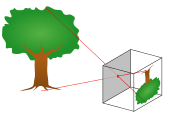
The basic way a pinhole camera works
The most notable innovations were in the field of optics and
vision, which came from the works of many scientists like Ibn Sahl, Al-Kindi, Ibn al-Haytham, Al-Farisi and Avicenna. The most notable work was The Book of Optics (also known as Kitāb al-Manāẓir),
written by Ibn al-Haytham, in which he conclusively disproved the ancient Greek
idea about vision, but also came up with a new theory. In the book, he
presented a study of the phenomenon of the camera obscura (his thousand-year-old version of
the pinhole camera) and delved
further into the way the eye itself works. Using dissections and the knowledge
of previous scholars, he was able to begin to explain how light enters the eye.
He asserted that the light ray is focused, but the actual explanation of how
light projected to the back of the eye had to wait until 1604. His Treatise
on Light explained the camera obscura, hundreds of years before the
modern development of photography.
The seven-volume Book of Optics (Kitab
al-Manathir) hugely influenced thinking across disciplines from the theory
of visual perception to the
nature of perspective in
medieval art, in both the East and the West, for more than 600 years. Many
later European scholars and fellow polymaths, from Robert Grosseteste and Leonardo da Vinci to René Descartes, Johannes Kepler and Isaac Newton, were in his debt. Indeed, the influence of Ibn
al-Haytham's Optics ranks alongside that of Newton's work of the same title,
published 700 years later.
The translation of The Book of Optics had a
huge impact on Europe. From it, later European scholars were able to build
devices that replicated those Ibn al-Haytham had built, and understand the way
light works. From this, important inventions such as eyeglasses, magnifying
glasses, telescopes, and cameras were developed.
Classical

Galileo Galilei showed a modern appreciation for the
proper relationship between mathematics, theoretical physics, and experimental
physics.
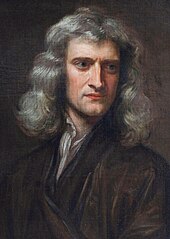
Sir Isaac Newton (1643–1727), whose laws of motion and universal
gravitation were major milestones in classical physics
Physics became a separate science when early modern Europeans used
experimental and quantitative methods to discover what are now considered to be
the laws of physics.
Major developments in this period include the replacement of
the geocentric model of
the Solar System with the
heliocentric Copernican model,
the laws governing the motion of
planetary bodies (determined by Kepler between 1609 and 1619),
Galileo's pioneering work on telescopes and observational astronomy in
the 16th and 17th Centuries, and Newton's discovery and unification of
the laws of motion and universal
gravitation (that would come to bear his name). Newton
also developed calculus, the mathematical study of
change, which provided new mathematical methods for solving physical problems.
The discovery of new laws in thermodynamics, chemistry, and electromagnetics resulted from greater research efforts
during the Industrial Revolution as
energy needs increased. The laws comprising classical physics remain very
widely used for objects on everyday scales travelling at non-relativistic
speeds, since they provide a very close approximation in such situations, and
theories such as quantum mechanics and
the theory of relativity simplify
to their classical equivalents at such scales. However, inaccuracies in classical mechanics for
very small objects and very high velocities led to the development of modern
physics in the 20th century.
Modern
.jpg/170px-Max_Planck_(Nobel_1918).jpg)
Max Planck (1858–1947), the originator of the theory
of quantum mechanics
Albert Einstein (1879–1955), whose work on the photoelectric effect and
the theory of relativity led to a revolution in 20th century physics
Modern physics began
in the early 20th century with the work of Max Planck in quantum theory and Albert Einstein's theory of relativity. Both of these theories
came about due to inaccuracies in classical mechanics in certain
situations. Classical mechanics predicted
a varying speed of light, which
could not be resolved with the constant speed predicted by Maxwell's equations of
electromagnetism; this discrepancy was corrected by Einstein's theory of special relativity, which
replaced classical mechanics for fast-moving bodies and allowed for a constant
speed of light. Black-body radiation provided
another problem for classical physics, which was corrected when Planck proposed
that the excitation of material oscillators is possible only in discrete steps
proportional to their frequency; this, along with the photoelectric effect and
a complete theory predicting discrete energy levels of electron orbitals, led to the theory of quantum mechanics
taking over from classical physics at very small scales.
Quantum mechanics would come to be pioneered by Werner Heisenberg, Erwin Schrödinger and Paul Dirac. From this early work, and work in related
fields, the Standard Model
of particle physics was derived. Following the discovery
of a particle with properties consistent with the Higgs boson at CERN in
2012, all fundamental particles predicted
by the standard model, and no others, appear to exist; however, physics beyond the
Standard Model, with theories such as supersymmetry, is an active area of research. Areas
of mathematics in general are important to this field, such
as the study of probabilities and groups.
thanks for viewing my blog
Regards-
Sachin Dayal.


Comments
Post a Comment