TECHNOLOGY
Technology ("science of craft",
from Greek τέχνη, techne,
"art, skill, cunning of hand"; and -λογία, -logia[2]) is
the sum of any techniques, skills, methods,
and processes used in the production of goods or services or in the accomplishment of
objectives, such as scientific
investigation. Technology can be the knowledge of
techniques, processes, and the like, or it can be embedded in machines to
allow for operation without detailed knowledge of their workings. Systems (e.g.
machines) applying technology by taking an input,
changing it according to the system's use, and then producing an outcome are
referred to as technology systems or technological
systems.
The simplest form of technology is the development and use of
basic tools.
The prehistoric invention
of shaped stone tools followed by the discovery of how to control fire increased sources
of food. The later Neolithic Revolution extended this, and
quadrupled the sustenance available from a territory. The invention of
the wheel helped
humans to travel in and control their environment.
Developments in historic times, including the printing press,
the telephone,
and the Internet,
have lessened physical barriers to communication and
allowed humans to interact freely on a global scale.
Technology has many effects. It has helped develop more
advanced economies (including
today's global economy) and has allowed the rise of a leisure class. Many technological processes
produce unwanted by-products known as pollution and
deplete natural resources to the detriment of Earth's environment. Innovations have always influenced
the values of a society and raised new
questions in the ethics of technology. Examples include the rise
of the notion of efficiency in terms of human productivity,
and the challenges of bioethics.
Philosophical debates have arisen over the use of technology,
with disagreements over whether technology improves the human condition or
worsens it. Neo-Luddism, anarcho-primitivism, and similar reactionary movements
criticize the pervasiveness of technology, arguing that it harms the
environment and alienates people; proponents of ideologies such as transhumanism and techno-progressivism view continued
technological progress as beneficial to society and the human condition.
Definition and usage
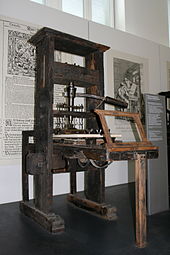
The spread of paper and printing to the West,
as in this printing press,
helped scientists and politicians communicate their ideas easily, leading to
the Age of Enlightenment; an
example of technology as cultural force.
The use of the term "technology" has changed significantly over the last 200 years. Before the 20th century, the term was uncommon in English, and it was used either to refer to the description or study of the useful arts or to allude to technical education, as in the Massachusetts Institute of Technology (chartered in 1861).
The term "technology" rose to prominence in the 20th
century in connection with the Second Industrial
Revolution. The term's meanings changed in the early 20th century
when American social scientists, beginning with Thorstein Veblen, translated ideas from the German concept
of Technik into "technology." In German and
other European languages, a distinction exists between technik and technologie that
is absent in English, which usually translates both terms as
"technology." By the 1930s, "technology" referred not only
to the study of the industrial arts but
to the industrial arts themselves.
In 1937, the American sociologist Read Bain wrote that
"technology includes all tools, machines, utensils, weapons, instruments,
housing, clothing, communicating and transporting devices and the skills by
which we produce and use them. Bain's definition remains common among scholars
today, especially social scientists. Scientists and engineers usually prefer to
define technology as applied science, rather than as the things that people make
and use. More recently, scholars have borrowed from European philosophers of
"technique" to extend the meaning of technology to various forms of
instrumental reason, as in Foucault's work on technologies of the
self (techniques de soi).
Dictionaries and scholars have offered a variety of definitions.
The Merriam-Webster Learner's Dictionary offers a
definition of the term: "the use of science in industry, engineering,
etc., to invent useful things or to solve problems" and "a machine,
piece of equipment, method, etc., that is created by technology. Ursula Franklin, in her 1989 "Real World of
Technology" lecture, gave another definition of the concept; it is
"practice, the way we do things around here. The term is often used to
imply a specific field of technology, or to refer to high technology or just consumer electronics, rather
than technology as a whole Bernard Stiegler, in Technics and Time, 1,
defines technology in two ways: as "the pursuit of life by means other
than life," and as "organized inorganic matter."[11]
Technology can be most broadly defined as the entities, both
material and immaterial, created by the application of mental and physical
effort in order to achieve some value. In this usage, technology refers to
tools and machines that may be used to solve real-world problems. It is a
far-reaching term that may include simple tools, such as a crowbar or wooden spoon,
or more complex machines, such as a space station or particle accelerator.
Tools and machines need not be material; virtual technology, such as computer software and business methods, fall under this definition of technology.] W. Brian Arthur defines technology in a similarly broad
way as "a means to fulfill a human purpose.
.jpg/220px-C4004_(Intel).jpg)
The invention of integrated circuits and
the microprocessor (here,
an Intel 4004 chip from 1971) led to the modern computer revolution.
The word "technology" can also be used to refer to a
collection of techniques. In this context, it is the current state of
humanity's knowledge of how to combine resources to produce desired products,
to solve problems, fulfill needs, or satisfy wants; it includes technical
methods, skills, processes, techniques, tools and raw materials. When combined
with another term, such as "medical technology" or "space
technology," it refers to the state of the respective field's knowledge
and tools. "State-of-the-art technology"
refers to the high technology available
to humanity in any field.
Technology can be viewed as an activity that forms or changes
culture. Additionally, technology is the application of mathematics,
science, and the arts for the benefit of life as it is known. A modern example
is the rise of communication technology,
which has lessened barriers to human interaction and as a result has helped
spawn new subcultures; the rise of cyberculture has at its basis the development of
the Internet and the computer. As a cultural activity, technology predates
both science and engineering, each of which formalize some aspects of
technological endeavor. In this sense, it remains connected with artistic
endeavors.
Science, engineering, and technology

Antoine Lavoisier experimenting with combustion generated
by amplified sun light
The distinction between science, engineering, and technology is
not always clear. Science is systematic knowledge of
the physical or material world gained through observation and experimentation. Technologies
are not usually exclusively products of science, because they have to satisfy
requirements such as utility, usability, and safety.
Engineering is the goal-oriented process of designing and making tools and
systems to exploit natural phenomena for practical human means, often (but not
always) using results and techniques from science. The development of
technology may draw upon many fields of knowledge, including scientific,
engineering, mathematical, linguistic, and historical knowledge, to achieve some practical result.
Technology is often a consequence of science and engineering,
although technology as a human activity precedes the two fields. For example,
science might study the flow of electrons in electrical conductors by
using already-existing tools and knowledge. This new-found knowledge may then
be used by engineers to create new tools and machines such as semiconductors, computers, and other forms of advanced technology. In this
sense, scientists and engineers may both be considered technologists;
the three fields are often considered as one for the purposes of research and
reference.
The exact relations between science and technology, in
particular, have been debated by scientists, historians, and policymakers in
the late 20th century, in part because the debate can inform the funding of
basic and applied science. In the immediate wake of World War II, for example, it was widely considered in the
United States that technology was simply "applied science" and that
to fund basic science was to reap technological results in due time. An
articulation of this philosophy could be found explicitly in Vannevar Bush's treatise on postwar science policy, Science
– The Endless Frontier: "New products, new industries, and more jobs
require continuous additions to knowledge of the laws of nature ... This
essential new knowledge can be obtained only through basic scientific research. In
the late-1960s, however, this view came under direct attack, leading towards
initiatives to fund science for specific tasks (initiatives resisted by the
scientific community). The issue remains contentious, though most analysts
resist the model that technology is a result of scientific research.
Thanks for having eyes at my blog
Regards
Sachin dayal.


This comment has been removed by the author.
ReplyDeleteNice wrk ✌
ReplyDelete